What the owner receives
- the rule
- received 9 differs from ordered 10
- the route
- goods receipt owner · Fjellheim Varehus · port 3
the answer
Waiting for the owner.

AI data, evaluation and implementation under one accountable delivery model.
Contact us Become a ContributorDOCUMENT AI WORKFLOW AUTOMATION
Document-triggered work, completed in the systems you already run. On this page one delivery note is classified, read, checked against the order, stopped, handed to the person who counted and written once.
THE READ 56 lines · 6 carried
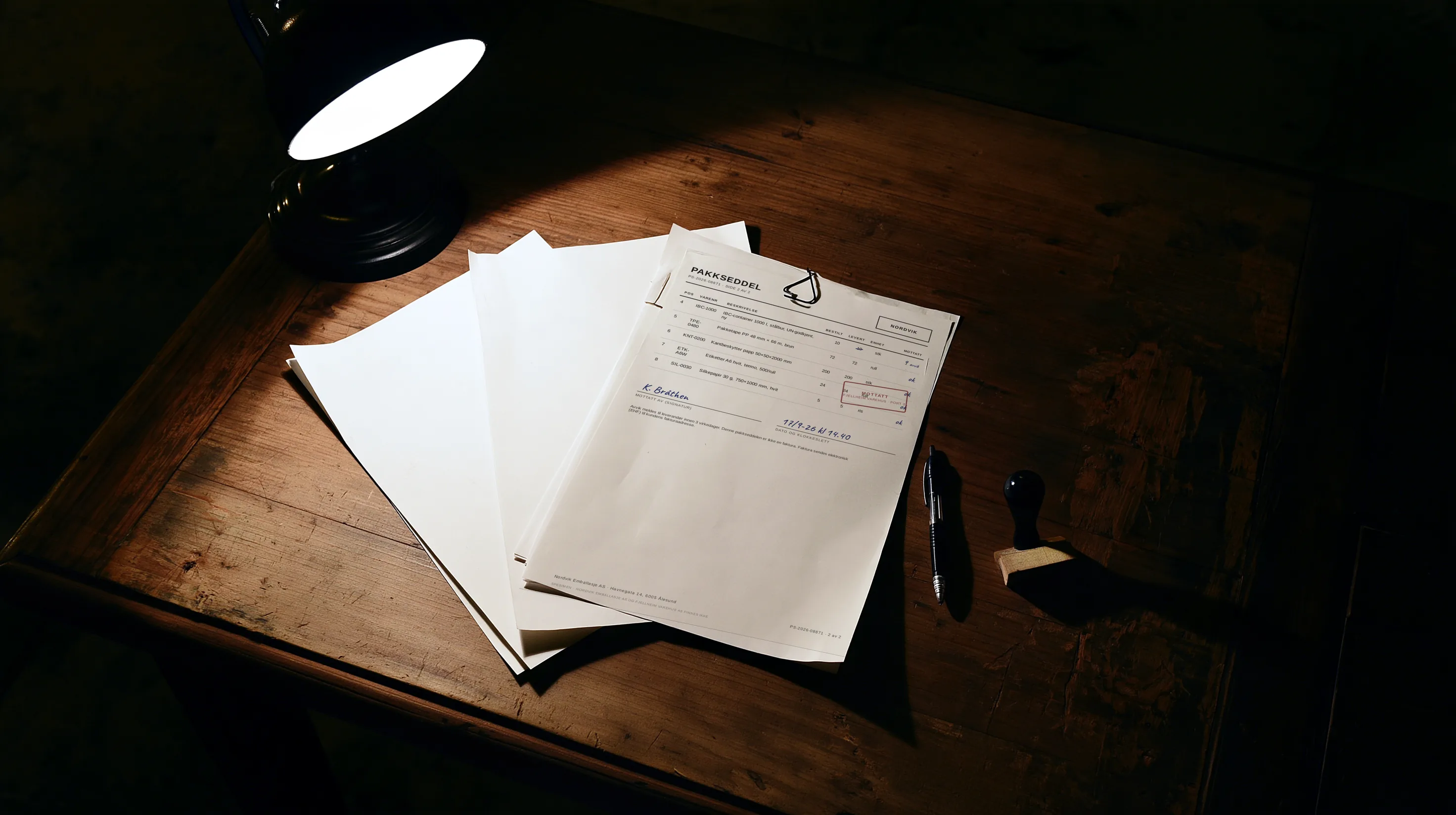
A delivery note of two pages, and a letter that does not belong to it. The letter is held for a person. Page two is read in 56 lines: the printed ten, the strike through it and the handwritten nine beside it are three of them.
 1 2 3
1 2 3 pages in the staple
Reading 56 lines on page two. The handwritten nine at 0.93 confidence. The stamp over the print, in two lines: the receiver's name at 0.99, MOTTATT at 0.97. The signature at 0.97, one letter wrong. The organisation number on page one passes its checksum.
A recorded read: PP-OCRv5 mobile, 12.3 MB, on the flat page, on one CPU, on 18 September 2026. The boxes are projected onto the photograph through the transform that laid the page there. The stop, the owner and the record below run live in this tab. A specimen. Nordvik Emballasje AS and Fjellheim Varehus AS do not exist.
THE STOP 10 ordered · 9 received
Ten in the order, ten in the electronic invoice, nine in handwriting on the note. The comparison runs in this tab on the value the reader found. Move the count and the verdict moves with it.
Stopped, one short
the rule
Received must equal ordered before the receipt is written. A checksum that fails stops the note before the count is compared.
Runs in this tab. No customer data.
THE OWNER one exception · one owner
The stop reaches the goods receipt owner with the evidence attached: the handwriting, cropped from the page, and the rule the count broke. Their answer runs the check again and releases the record.
What the owner receives
the answer
Waiting for the owner.
Runs in this tab. No customer data.
THE RECORD 6 fields · written once
The receipt is written into the system of record you name, with the page and the line each value came from. Throw the switch: the write parks, retries, and lands once when the system is back.
The receipt lands where the rest of your records are. A sample record from the specimen note. Move the count above and the record follows.
FOUR KINDS OF WORK 4 kinds · 1 workflow
In Norway the business invoice becomes structured data by law. The note, the claim, the form and the contract still arrive as pages. Each is read, checked against what it must agree with, and handed to an owner when the two disagree.
Kind 01
Goods and invoices
Kind 02
Claims and cases
Kind 03
Onboarding
Kind 04
Contracts
The kinds are named at scoping. The workflow is the one on this page.
BEFORE THE BUILD 3 rows · agreed first
Three things are agreed before the first production document is read.
THE BRIEF
The rules you sign start as these three lines.
Read from your brief. Edit it if it is wrong.
A named project lead reads it and replies within 24 hours with a first read on the classes, the rules and the evaluation set.
BEFORE YOU SCOPE
Classification, extraction, validation, review, routing and the system update, built as one workflow. On this page they are the read, the stop, the owner and the record.
Printed pages, handwritten entries on them, scans and photographs of pages, and files that already carry text. Each class is named before the build, with what it must yield and what an unknown is held as.
It is held as unknown for a person, together with the pages it came with. Extraction starts when that person names it.
Into the system of record you name, once, after the rules have passed or a person has decided. The record carries the page and the line each value came from.
The owner named for that rule. The exception reaches them with the crop from the page and the rule it broke, and their answer releases or corrects the record.
In Norway the invoice between bookkeeping-liable businesses becomes structured data by law. Foreign invoices, delivery notes, claims, forms and contracts still arrive as pages, and that is where the reading is.
Inside the boundary you sign: your cloud, a dedicated EEA tenant, a hybrid split or your own hardware. The deployment page names the four and what each one keeps inside.
The AI Implementation service line covers discovery, architecture and the deployment itself.